Tracking Progress Beyond the Scale: What Really Matters
The scale does not measure water, muscle or hormones. What to track instead to see your real weight loss progress in Tunisia, week after week.
You step on the scale every morning, and the number decides your mood for the day. It is an almost universal habit, and yet the scale is one of the least reliable tools for judging any single day, even though it stays useful over time. Understanding what it actually measures, and what it does not, changes how you track progress entirely.
What the scale does not tell you
- Water makes up a huge share of body weight, and it easily swings by a kilo or two from one day to the next depending on salt intake, hydration, sleep or stress.
- Glycogen holds water with it: after a carb-heavy meal, or conversely after several days of restriction, the amount of glycogen stored in your muscles changes, and the water that comes with it changes too.
- The hormonal cycle, for women, often comes with temporary water retention during certain phases, which can amount to several hundred grams, sometimes more, with nothing to do with body fat.
- The scale cannot tell muscle from fat. If you are gaining muscle while losing fat, which happens often for beginners, the number can stay roughly stable even though your body is genuinely changing.
- A heavy meal, slower digestion, an intense workout the day before: any of these can move the number with no real connection to actual fat gain or loss.
The result: a poorly read scale can convince you that you are failing when you are actually progressing, or the reverse.
How to use the scale intelligently, without giving it up
The scale is still a useful tool, as long as you change how you read it.
- Weigh yourself under the same conditions, ideally in the morning, on an empty stomach, after using the bathroom, to limit variables.
- Look at the trend over several weeks, not the number of the day. A seven-day average smooths out nearly all water and digestion fluctuations.
- Ignore a single worrying weigh-in. One high day does not cancel out three weeks of real progress.
What is worth tracking instead, or alongside
Photos, taken regularly. Same spot, same lighting, same posture, every two to four weeks. Changes in body composition often show up in a photo long before they show on the scale.
Body measurements. Waist, hips, thighs or arms tell a different story than weight: a smaller waist with no weight loss often means fat loss offset by muscle gain.
Strength and performance. Lifting heavier, running longer, completing more reps than a month ago is a solid sign of progress, independent of whatever the scale says that day.
How your clothes fit. Trousers that sit more comfortably at the waist, a shirt that pulls less: these often-overlooked signals are sometimes more reliable than the morning number.
Your energy and sleep. Feeling less tired by the end of the day, climbing stairs more easily, sleeping better: real progress that no number captures directly.
Your relationship with food. Eating without excessive guilt, resisting a passing craving more easily, naturally returning to your habits after a slip: behavioural progress that often lasts longer than any figure.
Building a balanced way to track progress
A good tracking system never relies on a single indicator. Combine instead:
- 1.Regular weigh-ins, read as a weekly average rather than day by day.
- 2.Photos or measurements, every two to four weeks, to see what the scale does not show.
- 3.A performance marker, like weight lifted or distance covered, to track your strength and fitness.
- 4.Attention to how you generally feel - energy, sleep, mood - which stays the most direct signal of whether your approach is working for you over time.
Simple tools for tracking your progress
You do not need fancy equipment to put this tracking in place. A tailor's tape measure, your phone camera and a notebook or a note app are plenty.
- The tape measure: measure your waist at the level of the belly button, always at the same time of day, ideally in the morning.
- Photos: use the same room, the same time of day and the same outfit, to limit the lighting differences that skew the comparison.
- A notebook or an app: log your measurements, how you feel, and your training performance, without aiming for perfection in the tracking itself.
What a month of tracking might look like
Take a typical month. In week one, the scale shows an encouraging drop. In week two, it stalls, even though your waist has shrunk by half a centimetre and a workout went better than usual. In week three, the number ticks up slightly after a well-watered family meal, with nothing unusual actually happening. In week four, the weekly average confirms a downward trend, consistent with the measurements and the photos. Taken in isolation, each week's number could have wrongly worried or reassured you. It is the overall picture, across several indicators, that tells the real story.
Common questions about tracking weight
How often should I take photos or measurements? Every two to four weeks is plenty; more often does not add useful information, since visible changes take time to appear.
What if my weight stalls but my measurements improve? Trust the measurements. This is a common sign of body recomposition, where fat decreases while muscle is maintained or grows.
Should I track every indicator at once? No. Pick two or three that genuinely speak to you, rather than measuring everything and exhausting yourself with the tracking itself.
Is it normal for my weight to differ between a home scale and one at a clinic? Yes, scales can vary slightly from one another, sometimes by a full kilo, depending on calibration and even the flooring underneath them. What matters is staying consistent with the same scale over time, not comparing readings across different devices or brands.
When the number worries more than it helps
For some people, daily weigh-ins become a source of anxiety rather than a useful tool, to the point of shaping mood or food choices excessively. If tracking your weight becomes a significant source of stress or obsession, or if you recognise problematic eating patterns in yourself, talk to a healthcare professional. Weighing yourself less often, or even pausing it temporarily to focus on other indicators, is a perfectly valid option.
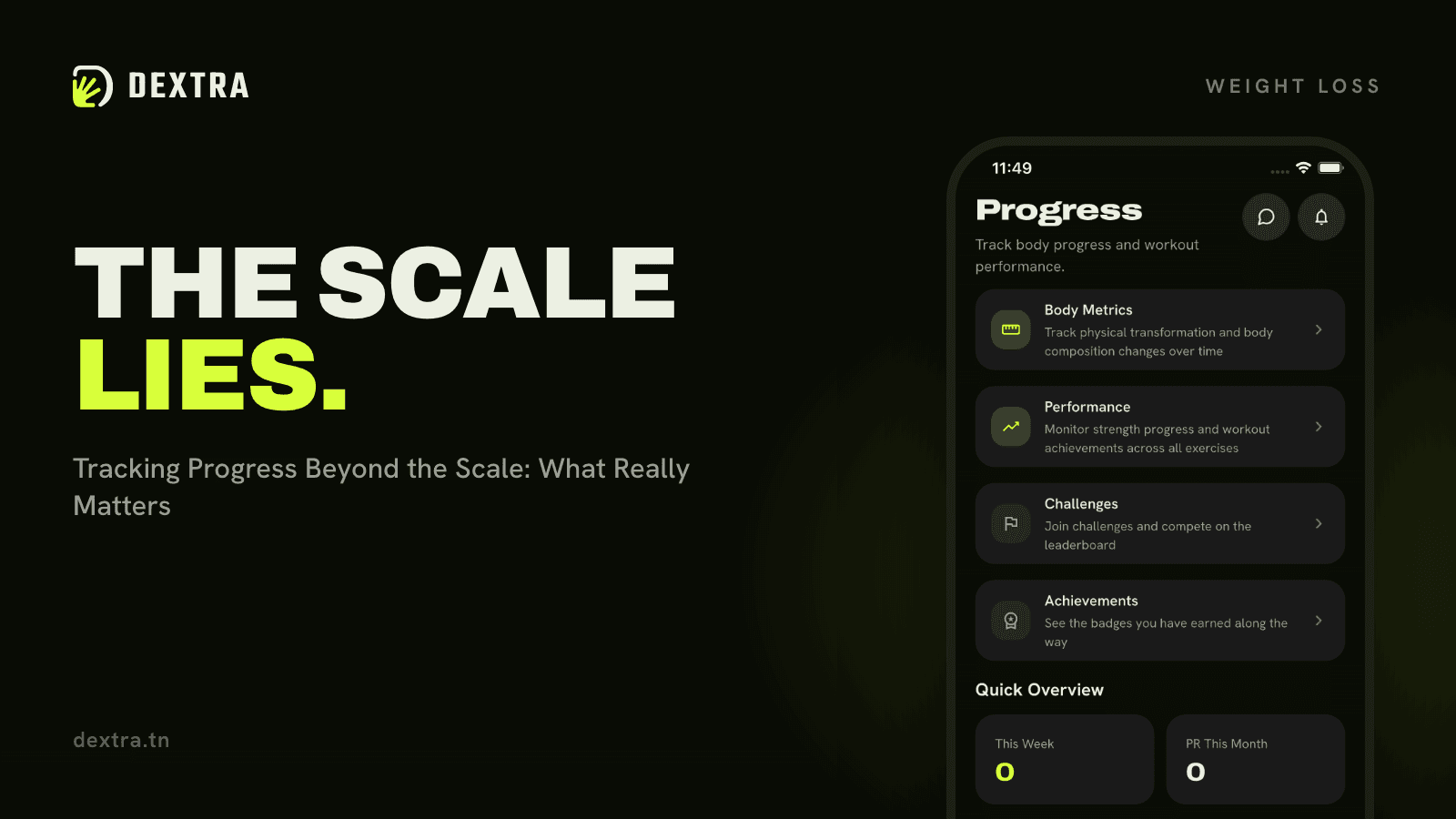
On Dextra, tracking combines several indicators with your coach, not just weight, so you can see your real progress even in weeks when the scale does not move. You can start for free at dextra.tn to try this kind of complete tracking.
Related guides
Ready to start your journey?
Download Dextra and get a personalized plan built for your goals.
Download Dextra