Online Fitness Coach in Algeria: The Complete 2026 Guide
How online fitness coaching works in Algeria, who it suits, what actually shapes the monthly cost, and how to choose a serious, certified coach.
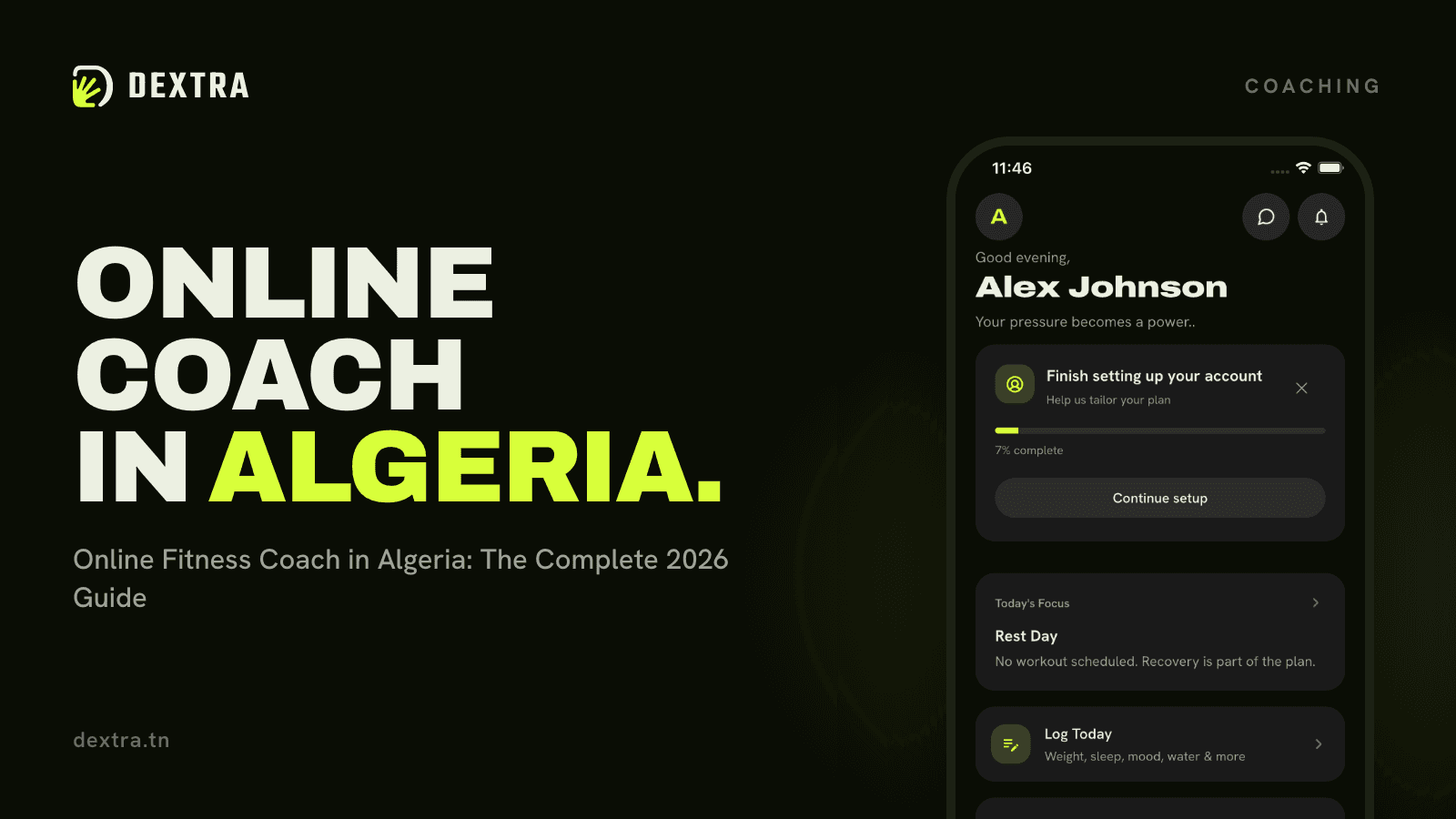
In Algeria, the hard part was never finding a workout plan — it's finding someone who actually keeps track of you. The country is vast: someone in Algiers can pick from ten gyms in their own neighbourhood, while someone in Tébessa or Béchar might drive an hour to reach the nearest one. Access to serious coaching has never been equal. An online fitness coach in Algeria changes that: the quality of your follow-up no longer depends on your postcode, only on your phone. This guide explains how it actually works, who it suits, and how to spot a coach worth trusting.
Online fitness coaching, in practice
Forget the image of a single PDF sent once by a stranger on social media. Real online coaching runs on a cycle: a qualified coach builds your programme, you train on your own, you report back on your sessions, and the coach adjusts the following week. It's a continuous back-and-forth, not a static file.
The difference from a generic app comes down to one word: adaptation. An automated programme doesn't know you're coming back from a knee injury, that you work shift patterns in Hassi Messaoud, or that all you have at home in Béjaïa is a mat and two dumbbells. A human coach does.
Why this model makes sense in Algeria
Several Algerian realities make online coaching particularly relevant:
- The country's geography. Certified coaches and well-equipped gyms cluster in Algiers, Oran, Constantine and a handful of major cities. Someone in Ghardaïa, Tiaret or Annaba deserves the same level of support without having to relocate.
- The sharply contrasting climate. A summer in coastal Oran has nothing to do with a summer in Ouargla or Biskra, where afternoon temperatures make outdoor training risky. An online programme adapts to your local climate, not a national average.
- Work hours and traffic. Between rush-hour congestion in Algiers and long working days, fitting a fixed gym slot into your week is often the first thing to go. A programme you do at home, whenever suits you, removes that constraint.
- Comfort and privacy for some women. Many women prefer training at home rather than in a mixed or crowded gym. Serious home-based follow-up gives them real support without that barrier.
How it unfolds, week by week
A serious online programme always follows the same logic, whoever the coach is:
- 1.A full initial assessment. You answer precise questions about your goal, your level, any pain or past injuries, the equipment you have, and how many sessions are realistic in your week.
- 2.A programme built for you. Exercises, sets, reps, rest times, with demonstration videos. If you have no gym and no equipment, the programme is built around bodyweight and whatever you have on hand.
- 3.Nutrition guidelines that fit your life. Not a one-size-fits-all diet, but reference points on protein intake, meal structure, and how to work in a Friday couscous or a family meal without guilt.
- 4.A weekly check-in. You send your feedback: sessions completed, how you felt, weight, measurements. The coach reviews it and adjusts load or volume for the coming week.
- 5.Open messaging. Between check-ins, you ask questions directly in the app — an unusual pain, a doubt about your form, a work trip to Sétif that throws off your schedule.
With Dextra, this whole journey happens inside one app, available in French, Arabic and English, with certified coaches.
Online coaching or the gym: what actually changes for you
The content of the programme. At the gym, without a personal trainer, you often follow a generic programme found online or copied from a friend. Online, the programme is built for your body and evolves every week based on your feedback.
Schedule flexibility. You don't need to sync your calendar with a gym's opening hours. A session at 6am before work or at 10pm after putting the kids to bed works just as well.
Equipment. A gym offers heavy equipment you won't find at home. But to lose fat, get back in shape or build a solid base, bodyweight training, resistance bands and a pair of dumbbells are more than enough for several months.
Consistency of follow-up. At a regular gym, nobody chases you if you skip two weeks. Online, the coach notices and reaches out.
What matters when choosing a coach
This is what determines whether your investment pays off. Here's what to check before committing.
- Verifiable training. A state diploma, a degree in sports science, or a recognised international certification. A serious coach shows it without being asked twice.
- A real initial assessment. If you receive a programme five minutes after your first message, with no questions about your history or schedule, that programme wasn't built for you.
- A clear follow-up frequency. Ask how often the programme gets adjusted and how quickly the coach answers messages. Weekly adjustment is the minimum standard.
- Honesty about results. Be wary of any promise of transformation in a few weeks. A serious coach talks about consistency, not miracles.
- Nutrition that fits your kitchen. The coach should work with chorba, couscous and everyday bread, not hand you a plan imported from somewhere with no connection to your life.
The mistakes that stall progress
Trying to change everything in one week. Five sessions, a strict diet and ten thousand steps a day starting from the first Monday: this pace almost always collapses within a month. Start with what you can actually sustain, two or three sessions, and build up gradually.
Not sending your check-ins. Online coaching only works if you feed the system information. Without your feedback, the coach has nothing to adjust.
Switching coaches or programmes too fast. Progress comes from repetition, not constant novelty. Let a programme run for several weeks before judging its results.
What it costs, and where to check
The price of online coaching mostly depends on the level of follow-up: how often the programme is adjusted, how available the coach is by message, whether nutrition is included. A single static programme sent once shouldn't cost much, but it won't deliver lasting results either. Real weekly follow-up is a monthly investment comparable to a decent gym membership.
Dextra bills its plans in Tunisian dinars (TND), the app's reference currency. Exact rates and the details of each plan are available at any time on the pricing page at dextra.tn — that's the most reliable source, since it reflects the prices actually in effect when you check.
Where to start this week
- 1.Set a clear, measurable goal, not a vague intention. "Three sessions a week for two months" can be tracked; "get fit" cannot.
- 2.Look at your week as it actually is, not as you wish it were. Two sessions you stick to beat five you abandon after ten days.
- 3.Choose a coach by checking the points above, even if it means talking to a few before deciding.
- 4.Block your slots in your calendar, like a non-negotiable work meeting.
- 5.Do your first session without chasing perfection. The goal of week one is to start, nothing more.
If you'd like to try this with a certified coach, the Dextra app is free on iOS and Android, with a free plan so you can explore the interface before committing to paid follow-up.
Related guides
Ready to start your journey?
Download Dextra and get a personalized plan built for your goals.
Download Dextra