Intermittent Fasting in Tunisia: Life After Ramadan
Intermittent fasting explained simply: who it suits, who should avoid it, and how Tunisians can keep the Ramadan habit going the rest of the year.
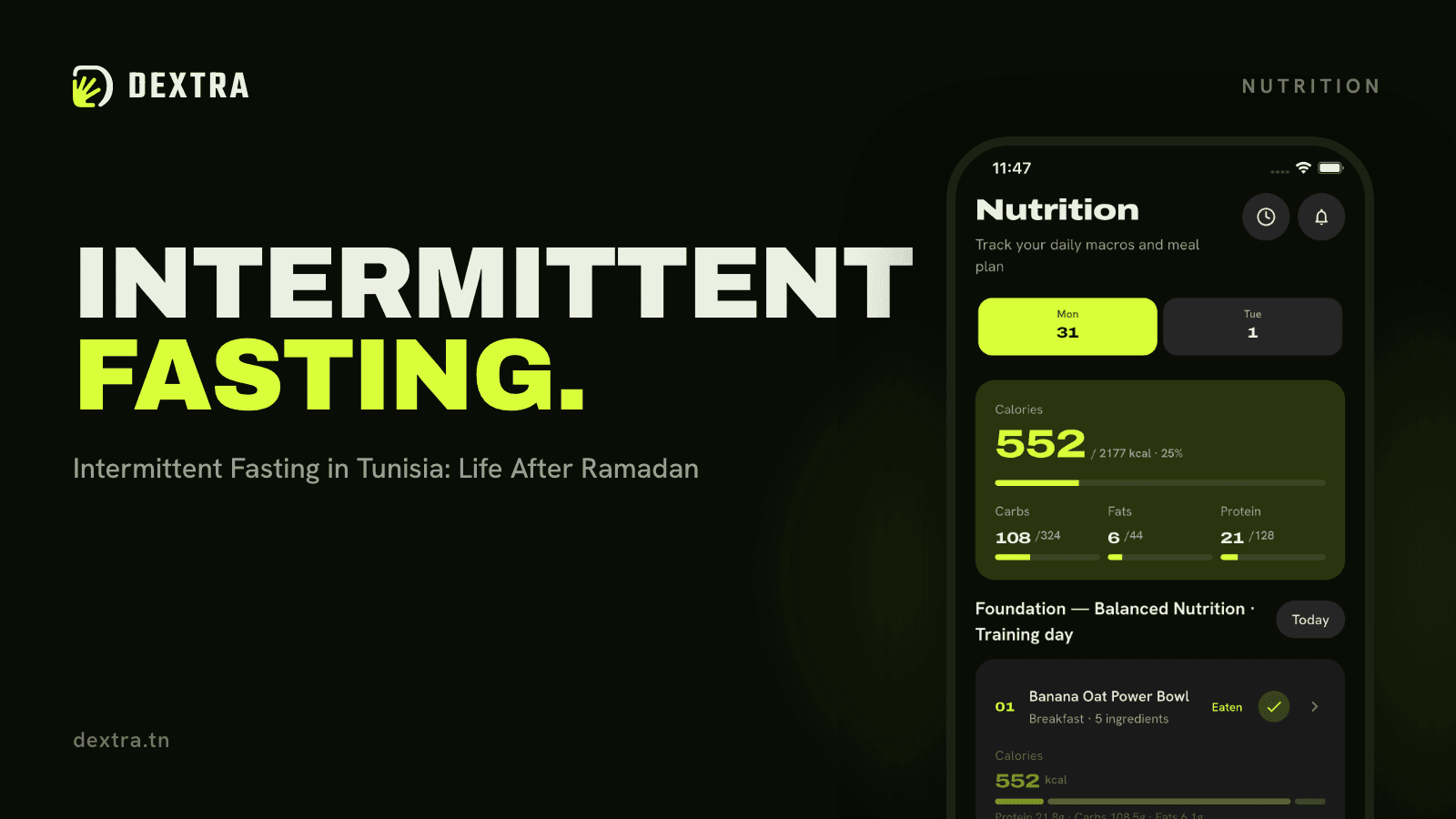
Intermittent fasting has become one of the most searched nutrition topics of recent years. In Tunisia, it has a feature most foreign articles never mention: a large part of the country already practises, once a year, a form of fasting far more demanding than any trending protocol. So the question is not "can you fast" — you already know how. The real question is whether it is a useful tool for you outside of Ramadan, and how to use it without turning it into another rulebook.
What intermittent fasting actually is
Intermittent fasting is not a diet in the usual sense: it says nothing about what you should eat, only when. The idea is to concentrate your meals into a shorter window than usual, and eat nothing — sometimes only water, tea or black coffee — outside that window.
The most common format limits eating to roughly an eight-hour window during the day, with a fast across the rest of the twenty-four hours. Other variants exist, with longer or shorter windows. No single version is universally "the best" — it is an organisational tool, not a magic formula.
Why it works for some people
Intermittent fasting has no special metabolic power beyond its simplest effect: it often, almost mechanically, reduces the number of eating occasions in a day. For someone who snacks easily or struggles to stop once they start eating, having fewer open windows in the day can be enough to create a calorie deficit naturally, without actively thinking about it.
It also works well organisationally: one or two structured meals a day, rather than five small ones to manage, simplifies life for a lot of people juggling work or studies on a busy schedule.
What intermittent fasting is not
It is not a magic mechanism that "cleanses" the body or fundamentally changes your metabolism beyond what any calorie deficit already does. It is not a guarantee of weight loss either: if you compensate by eating a lot more during your eating window, you can stay at the same weight, or even gain.
It is a timing tool, not a replacement for the basic principle: eating less energy than you burn to lose weight, or the reverse to gain. If organising a shorter window does not change what or how much you eat, it gives you nothing beyond a differently structured meal.
Who it suits, and who it does not
It can suit:
- someone who is not hungry in the morning and naturally prefers to skip breakfast.
- someone whose work schedule makes eating several small meals through the day impractical.
- someone who snacks without real hunger, for whom a shorter window cuts that habit down.
It suits less well:
- someone who needs to eat regularly to train hard in the morning, unless session timing is carefully adjusted.
- someone whose work or studies demand constant focus and who feels a marked energy dip during extended fasting.
- someone with a history of disordered eating, for whom restricting time windows can reactivate harmful patterns.
There is no universal right answer here — only what lets you stay consistent without your whole life revolving around the clock.
Using the Ramadan habit outside of Ramadan
Ramadan imposes a fast far longer and stricter than any intermittent fasting protocol: no water, no food from sunrise to sunset, for a full month. Many Tunisians finish the month with a genuine habit of concentrated meals built around suhoor and iftar — a habit that often fades in the weeks that follow as meals drift back into scattered timing.
If that structure worked well for you during Ramadan — organised meals, less snacking in between, some discipline around timing — nothing stops you from keeping a lighter version of it the rest of the year, as ordinary intermittent fasting with free access to water throughout the day. It is far simpler than Ramadan fasting since you can drink freely, and it helps you hold on to a habit that took a full month to build.
On the flip side, if Ramadan was particularly hard on you physically or mentally, that is not a sign you should push intermittent fasting the rest of the year. It is a signal worth listening to.
How to start without white-knuckling it
- 1.Start gradually: push your first meal back by an hour for a few days rather than jumping straight to an eight-hour window.
- 2.Keep hydrating: water, tea or black coffee during the fasting period, especially given how much of the year is hot in Tunisia.
- 3.Do not turn your eating window into permission to eat anything: what is on your plate still matters exactly as much as before.
- 4.Listen to clear signals: dizziness, sharp irritability, a drop in focus at work or during training are not signs to ignore or push through.
If intermittent fasting becomes more of a burden than a help at some point, dropping it is not a failure. It is one tool among several, not an obligation.
Common mistakes to avoid
- Compensating by eating twice as fast inside the eating window out of fear of missing out — this often cancels out the point of fasting.
- Ignoring signs of extreme fatigue, assuming it will pass, when the body is clearly asking for a break.
- Copying someone else's exact protocol without accounting for your own work, sleep or training schedule.
- Turning fasting into a constant topic of conversation that isolates you socially, when it is supposed to simplify your life, not complicate it.
These are organisational traps, not inevitabilities: fixing them is often enough to make intermittent fasting far more comfortable.
Fasting and training: getting the timing right
If you train in a fasted state, low-to-moderate intensity work — walking, light cardio, mobility — is usually well tolerated by most healthy adults. Heavy strength training or high-intensity intervals are a different story: many people perform noticeably worse fasted, especially in the first few weeks of adapting. A simple fix is scheduling your hardest sessions close to the end of your fasting window, so you refuel soon after, or shifting your eating window itself to wrap around training rather than fighting it.
When to talk to a health professional
If you are pregnant, have diabetes, a history of disordered eating, or any other medical condition, talk to a doctor before starting intermittent fasting outside of religious Ramadan fasting. Ramadan fasting itself carries exemptions for exactly these situations, because it is not risk-free for everyone; a voluntary fast deserves the same caution.
Intermittent fasting is neither a trend to dismiss nor a miracle fix: it is a timing tool that helps some people structure their meals better, nothing more. If you want to test the format that fits you, with support that adapts to your rhythm including around Ramadan, Dextra's certified coaches can guide you directly inside the app.
Related guides
Ready to start your journey?
Download Dextra and get a personalized plan built for your goals.
Download Dextra