Fitness Coach or Nutritionist: Who Should You See?
Fitness coach, nutritionist, registered dietitian, strength and conditioning coach: who does what, who is qualified for what, and what a coach must never do.
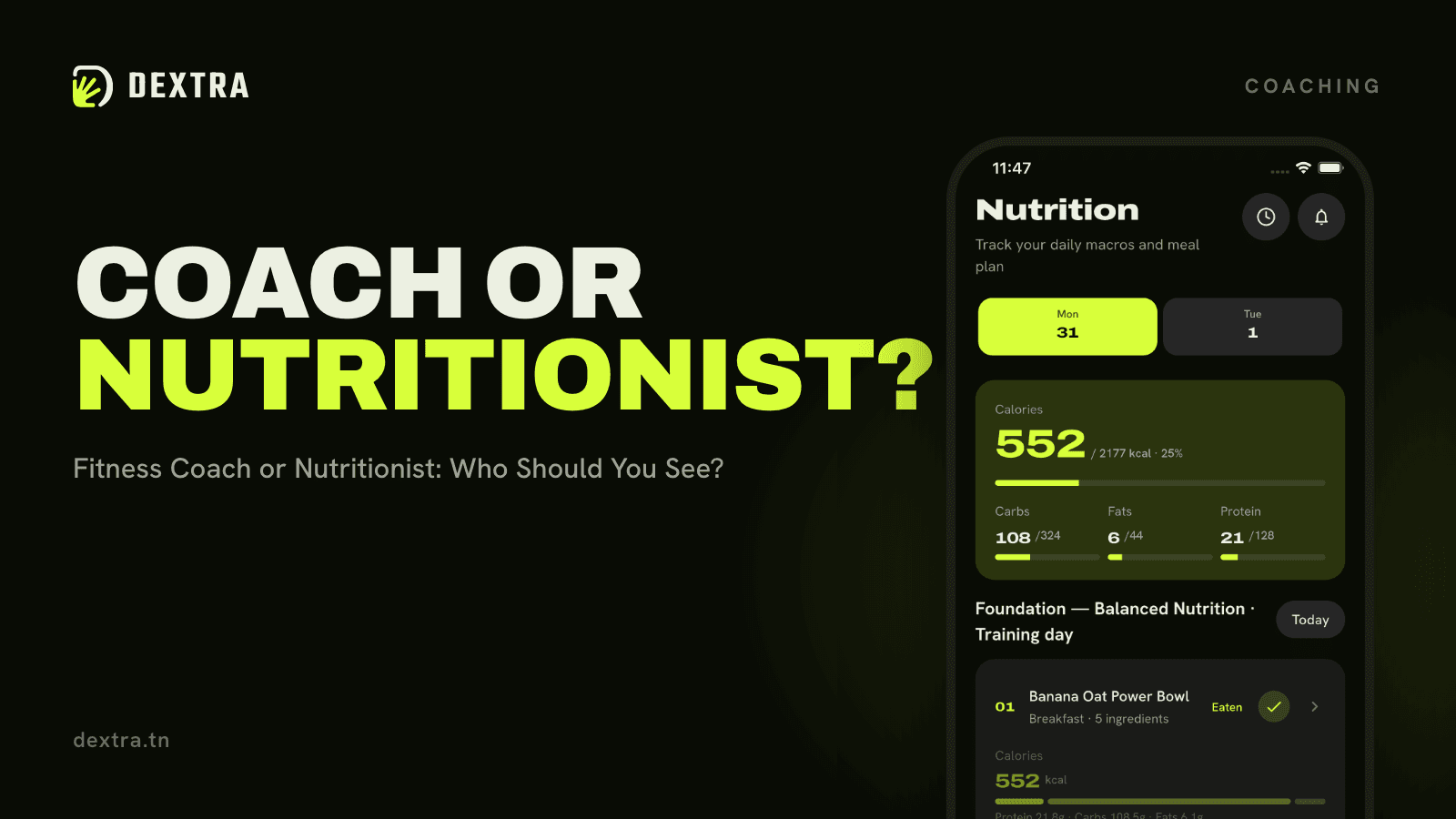
"My coach put me on a diet" is a sentence you hear often, and one that should usually raise an eyebrow. Fitness coach, personal trainer, strength and conditioning coach, nutritionist, registered dietitian: these titles sound alike, sometimes overlap in practice, but cover very different skill sets and legal frameworks. Knowing who does what saves you from paying for advice outside someone's actual competence, and above all from following recommendations that should never have come from them in the first place.
The fitness coach or personal trainer: movement, not the plate
A fitness coach is trained to design and supervise training: exercise selection, technique, load progression, session structure, and preventing injuries linked to movement. That is the core of the job, and a good coach dedicates most of their expertise to it.
On nutrition, a competent fitness coach can offer general, common-sense guidance: spreading meals better across the day, increasing protein and vegetable intake, drinking more water, cutting back on random snacking. These are lifestyle recommendations, valid for nearly every healthy adult, not an individualised meal plan built on a clinical assessment.
The strength and conditioning coach: sport-specific performance
Often confused with a generalist fitness coach, a strength and conditioning coach works mainly with athletes, advanced amateurs or competitors, on precise physical qualities tied to a discipline: speed, power, sport-specific endurance, and preventing injuries typical of a given sport. They frequently collaborate with a technical coach and sometimes a medical team. This is generally not the right person for a beginner who simply wants to get back into shape, nor for clinical nutrition questions.
The nutritionist: the broadest title, worth checking case by case
"Nutritionist" is not a single title protected the same way everywhere: it can refer to a physician specialised in nutrition, or to someone who has completed a short private course in nutrition with no medical or paramedical qualification. The difference is considerable. Before following a "nutritionist's" advice, always ask what qualification sits behind the title: a physician specialised in nutrition, a registered dietitian, or an unregulated private course. All three sometimes hide behind the same word, with very different levels of competence.
The registered dietitian: the regulated nutrition professional
A registered dietitian is trained specifically in the science of nutrition, able to build an individualised meal plan that accounts for medical conditions, allergies, medication, or specific needs (diabetes, pregnancy, digestive disorders, kidney disease). This is who you should see as soon as a health issue enters the picture, alongside or on referral from a doctor.
A dietitian can work hand in hand with a fitness coach: one builds the meal plan suited to a medical condition, the other builds the training programme, and the two align on the broad strokes.
Who to see depending on your situation
- You simply want to move more and eat in a more balanced way, with no identified health issue: a competent fitness coach is plenty for training and general nutrition guidance.
- You are training for a competition or targeting a specific performance goal: a strength and conditioning coach, in addition to or instead of a generalist coach.
- You have a chronic condition (diabetes, high blood pressure, kidney disease, chronic digestive disorder): a registered dietitian, ideally in coordination with your doctor, before any meal plan.
- You are pregnant, postpartum, or have a significant medical history: medical advice comes before any fitness or nutrition guidance.
- You have a suspected or diagnosed eating disorder: a specialised health professional, not a coach and not even a generalist nutritionist.
What a fitness coach must never do
Certain limits are non-negotiable, regardless of a coach's experience or popularity.
- Diagnose or treat a medical condition. A coach is not a doctor; any unusual or persistent pain, or any concerning symptom, must be referred to a health professional without delay or improvisation.
- Prescribe a diet for a chronic illness. Diabetes, kidney disease, thyroid or digestive disorders are the domain of a dietitian or a doctor, never a coach acting alone.
- Recommend stopping medical treatment or changing a dosage, under any pretext.
- Sell supplements while presenting themselves as neutral. An obvious conflict of interest should be disclosed, not hidden.
- Promise a guaranteed health outcome. No serious professional, in any of these fields, can guarantee a specific physical result within a fixed timeframe.
The special case of Ramadan and family meals
In Tunisia, nutrition questions often come up around Ramadan or the big family meals on Friday or Sunday. A competent fitness coach can help you adapt your training to fasting hours, shift sessions to late afternoon or after iftar, and give general hydration guidance between iftar and suhoor. But as soon as a condition linked to fasting appears, such as diabetes, unstable blood pressure or reflux, the question moves beyond the coach's scope and belongs to a dietitian or a doctor, who alone can safely adjust treatment or diet during that period.
How to check who you are actually talking to
Before following any advice, especially on nutrition or a health matter, ask these simple questions:
- 1.What exactly is your qualification, and which institution issued it?
- 2.Do you work alongside doctors or dietitians for cases that go beyond your field?
- 3.In what case would you refer me to another professional rather than keep advising me yourself?
An honest professional answers these questions plainly, and knows the limits of their own field. That is often the best sign that they genuinely master it. If someone hesitates to answer, or tries to convince you that qualifications are a minor detail next to their practical experience, that hesitation is itself worth paying attention to.
A good fitness coach stays within their scope and points you elsewhere when a question goes beyond it. On Dextra, certified coaches based in Tunisia oversee training and general eating habits, without ever substituting for medical or dietetic advice when the situation calls for it. You can explore how this works for free at dextra.tn before deciding on closer, paid support.
Related guides
Ready to start your journey?
Download Dextra and get a personalized plan built for your goals.
Download Dextra