Fitness App in Morocco: How to Choose Well in 2026
Arabic and French support, average connections, offline mode, real coach versus pure automation: what to check before picking a fitness app in Morocco.
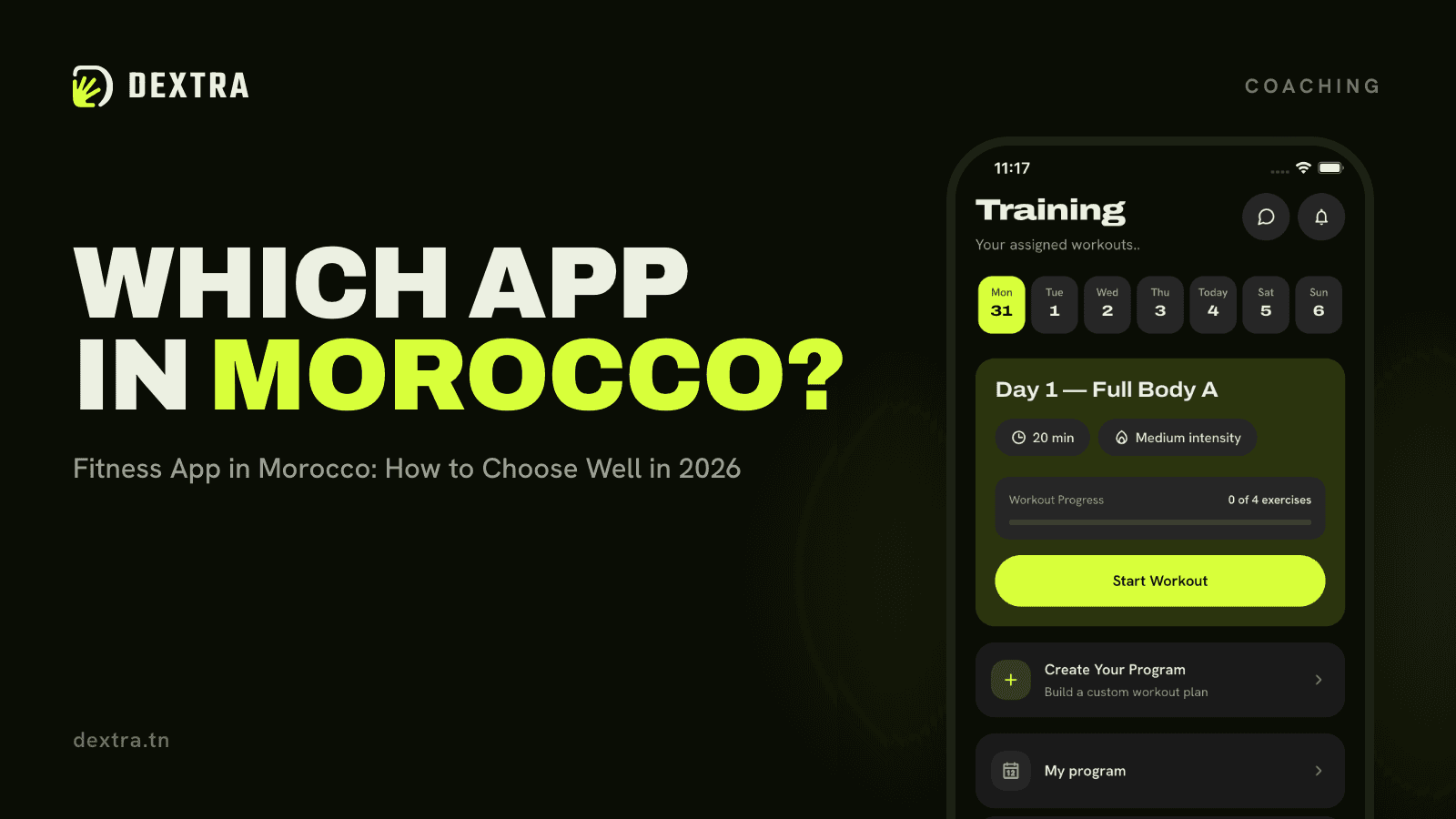
Open the App Store or Play Store from Casablanca, Marrakech or Tangier, and dozens of fitness apps appear, most of them built elsewhere for an audience that shares neither your eating habits, nor your internet connection, nor your two everyday languages. A fitness app in Morocco needs to meet specific needs before exercises even enter the conversation. Here is what separates a genuinely useful app from a half-translated video library.
Arabic and French, a non-negotiable minimum
In Morocco, people move naturally between French and Arabic, sometimes within the same sentence. A serious app should offer a complete interface in both languages, not just a translated menu while exercise instructions stay in English. Check this before downloading: open the language settings and test an actual programme, not just the welcome screen. A rushed translation, with garbled technical terms, gives away an app built for another market and adapted in a hurry.
An app that works on an average connection
Not every area of Morocco has a steady internet speed. Between central Casablanca and a town further from the coast or the main routes, 4G quality varies a lot, and home wifi is not always stable. A good fitness app should stay light: videos that load without excessive delay, an interface that does not crash the moment the signal weakens, and a reasonable loading time even on a limited data plan. If the app asks you to download several gigabytes of high-definition video before starting a simple session, that is not a technical footnote to ignore, it is a daily usability problem.
Offline mode, more useful than you would think
A train ride between Casablanca and Tangier, a basement gym with no signal, a trip to a region with weaker coverage: offline mode is not a gimmick, it is what lets you follow your session even without a connection at that exact moment. Check whether the app lets you download a programme in advance and run it offline, or whether it leaves you stuck on a loading screen at the worst possible time.
Real human coach or pure automation?
This is the most important question, and the most often overlooked. Many apps present themselves as "coaching" when what they actually offer is an algorithm handing the same generic programme to everyone, with automatic adjustments based only on numbers. That is not necessarily useless, but it is not the same as a real coach who reads your feedback, understands why you skipped a session for a family wedding, and adapts the plan accordingly.
Before committing, ask a simple question: who actually looks at my progress every week, a person or only an algorithm? An honest app states this clearly, without blurring the two in marketing language.
- Pure automation suits someone discovering fitness at a lower cost, or someone self-sufficient who already knows how to train.
- Real human coaching suits those who need personalised follow-up, answers to their questions, and adjustments that account for their actual life, not just their statistics.
Does the app actually understand your food?
This is often where imported apps fail most visibly. A food database built for another country does not recognise harira, tajine, msemen or argan oil. You end up searching for a rough English equivalent, or dropping nutrition tracking altogether for lack of relevant reference points.
An app adapted to Morocco should let you build meals from what you actually eat, without forcing you to translate your family cooking into a database designed elsewhere. Test this directly: search for a common Moroccan dish in the app before subscribing, and see what comes up.
Features to check before downloading
- Clear demonstration videos for every exercise, not just static diagrams.
- A programme that evolves, not a fixed list of identical exercises every week.
- Messaging with a real human, if the app includes coaching, not only an automated chatbot.
- A schedule that adapts to Ramadan and travel, rather than a fixed calendar that ignores real life.
- Payment methods accessible from Morocco, via international bank card.
- A clear personal data policy, especially if you share body measurements or progress photos.
None of this needs to be taken on trust. Most serious apps let you try a free plan or a trial period before you commit to a paid one, which is the simplest way to check these points yourself rather than relying on a store description.
What it costs and how to pay
With Dextra, the app is free to download on iOS and Android, with a free plan to explore how it works. Paid coaching plans are billed in Tunisian dinars (TND), the currency Dextra bills in, not Moroccan dirhams: there is no official conversion displayed, and payment is made by international bank card. For exact amounts, check the pricing page on dextra.tn rather than relying on an estimate.
Mistakes to avoid when choosing an app
Relying only on store ratings. A large number of downloads does not guarantee the app understands Moroccan cooking or climate. Read recent reviews that mention the actual day-to-day experience instead.
Ignoring the offline question until the day it fails. Test this feature from day one, not during an important trip.
Confusing generic content with personalised follow-up. A video library, however well filmed, adjusts nothing to your situation. Real coaching does, every week.
Downloading several apps at once. Spreading your follow-up across three different tools makes the programme incoherent. Pick one, test it seriously for several weeks, then decide.
Not checking how much data it consumes. If your mobile plan is limited, an app that streams large video files on every screen can eat through your data within a week. A well-built app compresses video sensibly and lets you cache a session once instead of reloading it every time.
How to test an app this week
- 1.Download the app and switch the language to Arabic then French, to check that everything is genuinely translated, down to the exercises themselves.
- 2.Search for a common Moroccan dish in the nutrition section, to see whether the database actually applies to you.
- 3.Turn on offline mode and test a session with no connection, if the app offers it.
- 4.Ask a question through messaging, if the app includes coaching, and see who answers and how quickly.
- 5.Compare what each plan actually includes, not just its displayed price.
A good fitness app in Morocco is not the one with the biggest exercise catalogue, but the one that adapts to your language, your connection, your cooking and your daily rhythm. The Dextra app was built with these constraints in mind, with certified coaches, an interface in Arabic, French and English, and a free plan to test it without commitment, available on iOS and Android.
Related guides
Ready to start your journey?
Download Dextra and get a personalized plan built for your goals.
Download Dextra