Fitness App in Algeria: What to Check Before You Download
Arabic support, patchy connections, a real coach versus automated videos, local food: what to check before choosing a fitness app in Algeria.
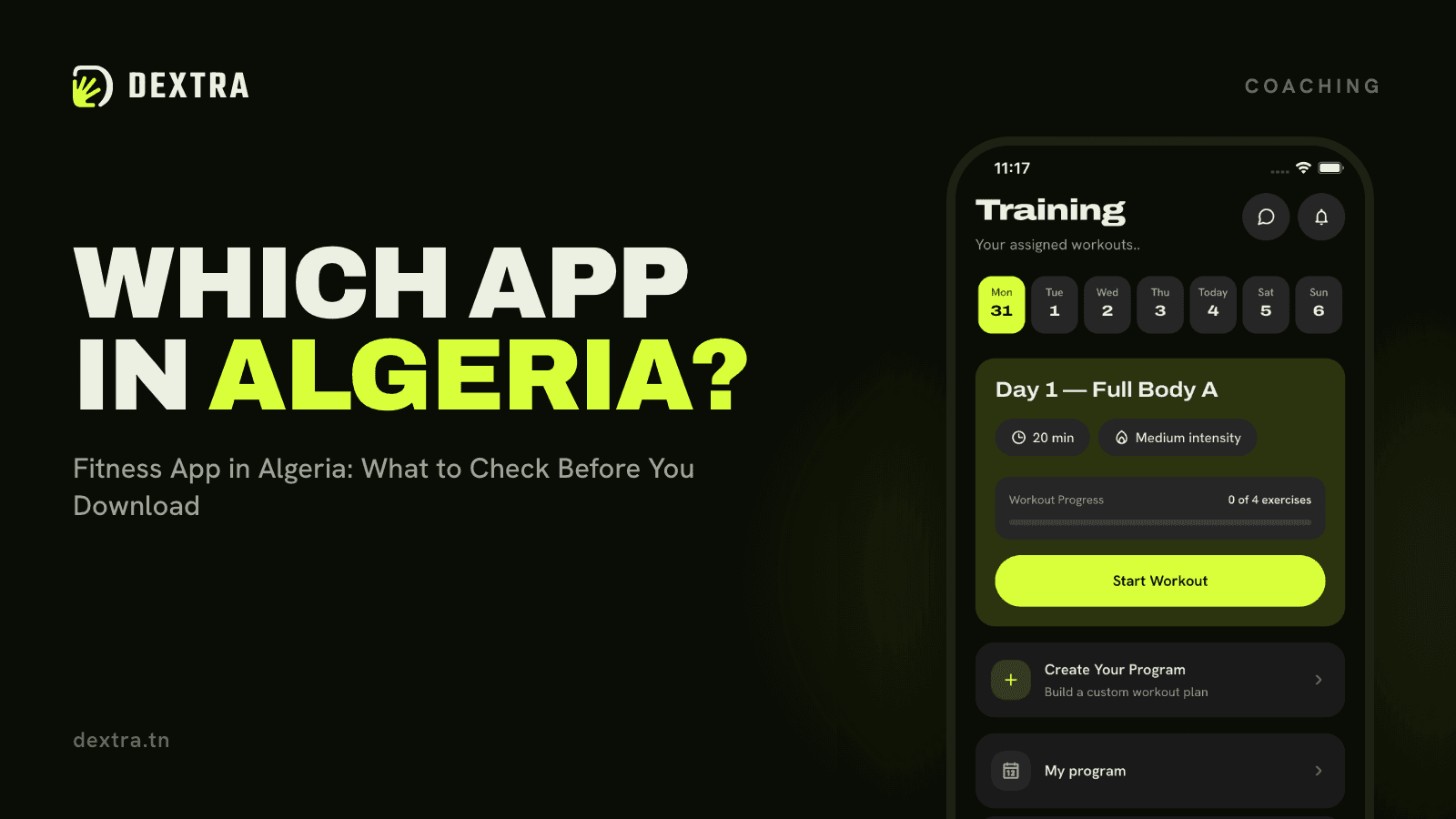
Downloading a fitness app in Algeria takes ten seconds. Choosing the right one takes a bit longer. The Play Store and App Store are full of apps that all look alike in their screenshots: toned bodies, transformation promises, a polished interface. The real difference lies elsewhere, in details no screenshot ever shows. This guide walks through what to check before committing, starting from the everyday realities of a user in Algeria: connectivity, language, the type of support on offer, and everyday food.
The first test: what happens when the app knows nothing about you?
Open the app and look at what it asks before offering you a programme. If three questions are enough (goal, level, duration), what you get is a generic template picked from a handful of variants, not a programme built for you. A serious app asks about your actual equipment, past injuries, your schedule, and what you hate doing, before building anything.
Real coach or pure automation: the distinction that matters most
Many apps call a library of videos sorted by category "coaching." That's not dishonest in itself, as long as it's stated clearly, but it isn't support. Nobody watches how you perform a movement, nobody adjusts your load when you've plateaued for three weeks, nobody answers when an unusual pain shows up.
Before committing, look for answers to these questions:
- Is the programme built and followed by an identifiable person with verifiable training?
- Does that person understand your context: the heat in the south, your work hours, family meals?
- Is human follow-up part of the listed price, or is it a paid add-on?
- Can you message a real coach and get a real answer, not an automated reply?
If the app stays vague on these points, treat it as a video library and judge it as such: that's not a flaw if it's what you're after, but it isn't coaching.
Language, beyond simple translation
An app you open every day needs to speak a language you're comfortable in. In Algeria, that often means switching between French and Arabic depending on the moment and who you're talking to. Check that the interface genuinely offers both, not just a language menu that translates a few buttons while leaving the rest in English.
For Arabic, check whether the switch to RTL (right-to-left) mode is complete: text alignment, the reading direction of exercise lists, button placement. A translation dropped onto an interface designed for French quickly becomes uncomfortable to use. And if you message a coach, check that the conversation can happen in the language you're most at ease using to describe pain or discomfort.
Working with an imperfect connection
Network quality in Algeria varies a lot depending on where you are: excellent in Algiers or Oran, patchier across the Hauts Plateaux or the deep south. A good fitness app needs to work in both cases.
Check two things before you get attached to an app:
- How much data it consumes. An app that loads high-definition video for every single exercise burns through a limited plan fast. Look for a data-saving mode or an option to lower video quality.
- Offline access. Can you view today's session without network, do it, then log your results once the connection comes back? That detail is what saves a session from being wasted on a day the network drops.
Nutrition that recognises what you actually eat
A generic nutrition plan translated from English often loops through chicken, rice and broccoli. That's not wrong or forbidden, but it isn't your kitchen. An app that understands local eating habits knows that a plate of chakhchoukha or rechta isn't a mistake to correct, but a meal to work into your week intelligently.
Check whether the app's nutrition guidance mentions foods you actually recognise: lentils, sardines, eggs, dates, semolina, legumes. If every example comes from somewhere else, the nutrition personalisation promised probably doesn't exist.
Progress tracking and privacy
Beyond the number on a scale, a useful app tracks several measures: weights lifted, number of reps, waist circumference, how you generally feel. A readable history over several weeks motivates more than a single isolated figure.
This data is sensitive. Before signing up, glance at the privacy policy: can you delete your account and your data easily? Does the app request permissions (contacts, constant location) unrelated to training? A serious app doesn't need access to your phone contacts to offer you a set of squats.
Reading reviews without being misled
Reviews on the Play Store and App Store help, as long as you read them properly. A high overall rating tells you nothing about what actually matters to you: it mixes users who wanted a simple video library with others who wanted real coaching. Look instead for reviews that describe a specific experience: how quickly the coach replied, difficulty cancelling a subscription, an issue with the Arabic interface. Those concrete details matter more than a star average.
Be wary too of a burst of reviews right after an app launches, usually more enthusiastic than representative. Reviews written months later, by users who have gone past the trial period, give a more honest picture of what the follow-up is actually like.
What to look at before you pay
- An identifiable, certified coach, or a video library clearly presented as one.
- An initial assessment that asks real questions, not three checkboxes.
- A complete interface in French and Arabic, with genuine RTL support.
- A data-saving mode and working offline access.
- Nutrition guidance built around foods you recognise.
- Progress tracking that goes beyond the number on a scale.
- A clear privacy policy and an account you can delete in a few taps.
- A free plan that lets you test before any financial commitment.
On pricing, Dextra bills its plans in Tunisian dinars (TND). The current details of each plan are available on the pricing page at dextra.tn — check there directly rather than relying on a figure that can change.
Test before you commit
No checklist replaces an actual trial. Download the app, answer the intake questionnaire honestly, do a first session, send a real message if the app offers messaging. The quality of the reply you get says more than any marketing description.
Dextra is a fitness coaching app free to download on iOS and Android, with an interface in French, Arabic and English, certified coaches, and a free plan so you can see how it works before committing.
Related guides
Ready to start your journey?
Download Dextra and get a personalized plan built for your goals.
Download Dextra